The Wedding of Rûmi, on December 17: Shab-e Arus, the night when the soul joins the Beloved

Shab-e Arus, the night when the soul joins the Beloved

There are, in the calendar of men, dates that seem ordinary, almost discreet. And yet, some of them vibrate like a secret rope: as soon as you brush against it, the heart recognizes an ancient song.

December 17th is one of those.

Because on December 17, 1273, in Konya, Jalâl ad-Dîn Rûmi left this world.

But in the intimate language of the Sufis, we do not talk about the end. We talk about union. We talk about marriage.

It is said Shab-e Arus, Şeb-i Arus in Turkish: the Wedding Night, the Union Night, the Return Night. And this name, in itself, reverses our way of looking at the invisible: for Rûmi, this passage is not a fracture, it is an encounter. It’s not erasure, it’s accomplishment.

A night called 'Noces'

Imagine for a moment: most traditions mourn what the world loses. Rûmi, he, contemplates what the soul finds.

In the Mevlevi vision, this night is not the remembrance of a disappearance; it is the celebration of a reunion with the Beloved, God, the Essence, the Source, whatever name one dares to give to infinity.

Then, the tears transform. They no longer fall like a complaint: they become purification water. And mourning, if it still exists, turns like a fabric: it shows, on the other side, a light.

Shrine of Rumi, Konya:

Konya, from December 7 to 17: a week to enter the spirit of the Wedding

In Konya, these commemorations do not last one evening. They take the form of a week (often from 7 to 17 December), with a peak around the 17th. 

Visitors come from all over the world, attracted by something beyond folklore: an atmosphere, a gentle gravity, a fervor without aggressiveness, an inner call.

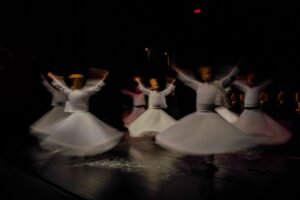
At the center of these days: the Sema, the sacred rotation ceremony of medieval tradition, intimately linked to Rûmi’s heritage. 

The Sema: a prayer in motion

It is sometimes believed that the Sema is a “show”. We are mistaken, or rather, we only see a surface.

Sema is a language. A strong word without sentences, but charged with meaning : the body becomes a letter, rotation becomes a sentence, breath becomes a verse. In its ritual form, the ceremony follows a precise structure, carried by mevlevie music and an inner progression. 

It’s not an art to shine.

It is an art to disappear, not to fade away, but to lighten up.

As if the human being, for a moment, ceased to believe himself separated.

And this is not a detail: the Sema mevlevi is recognized as intangible cultural heritage of humanity (UNESCO), which highlights its cultural and spiritual significance beyond borders.

What the Wedding of Rûmi asks us, today

It would be easy to let this night 'belong' to the 13th century. But the real sacred nights do not age: they move, they cross generations, and come knocking on our doors, at the exact moment we need them.

The Wedding of Rûmi asks a simple, and dizzying question:

And if the word 'wedding' troubles us, it may be because it does not only talk about the after. It talks about the now.

He speaks of inner union. Of peace that does not depend on circumstances. Of this fixed point, at the center of the spiral, where one ceases to struggle.

To go further: article, print, testimonials

If you wish to deepen, I invite you to: 

Because deep down, it might be that, the most beautiful definition of this night: 

A night where nothing is lost...

A night where we meet again.

References & sources

Britannica, entrée « Rumi »

1.Encyclopædia Britannica

Jalāl al-Dīn Rūmī: biography, date and place of death https://www.britannica.com/biography/Rumi

Explore
Rumi

2-Wikipedia (French version)

Djalâl ad-Dîn Rûmî: death in Konya on December 17, 1273, notion of Shab-e Arus https://fr.wikipedia.org/wiki/R%C3%BBm%C3%AE

Explore
Introduction à la danse soufie - Derviche Tourneur - Wirling Dervish

3-UNESCO – Intangible Cultural Heritage of Humanity

The Mevlevi Sema Ceremony : Official recognition of the Mevlevi ritual https://ich.unesco.org/en/RL/mevlevi-sema-ceremony-00100

Explore
Mevlana Museum -Voyage à Konya - avec Ranagorgani

4-Rumi Shrine, Konya

Ancient settlements discovered in the Konya Plain https://sacredsites.com/middle_east/turkey/shrine_of_rumi_konya.html

Explore

The historical and spiritual information presented in this article is based on recognized institutional, academic, and cultural sources, notably the Encyclopædia Britannica, UNESCO, the cultural institutions of Konya and academic reference works on the work and heritage of Jalal ad-Din Rumi. 

Share

Categories

Summary