Séminaire LES SEPT VALLÉES DU CŒUR : Date limite d’inscription : 30 Novembre 2026
La Sufi dance is a spiritual and artistic practice originating from Sufism, the mystical dimension of Islam. For centuries, it has been part of the Samâ, a ceremony where music, poetry and rotation allow one to enter a state of deep presence.
In this tradition, circular movement is not a mere choreography. It becomes a meditation in motion. As it rotates around its axis, the dervish seeks to find an inner centre, a point of calm at the heart of the movement. The rotation evokes the movement of the planets, the rhythm of nature, and the breath of life.
Sufi dance: much more than a dance
The practice is often known in the West today as Whirling dervish dance, the dance of the whirling dervishes. It is linked to the teachings of the great Persian mystic poet Jalāl ad-Dīn Rūmī, whose poetry celebrates love, spiritual ecstasy, and movement as pathways to self-knowledge.
Au cours du temps, la danse soufie s'est perpétuée comme un Body and consciousness art. It develops grounding, balance, presence, and inner listening. The body becomes an instrument connecting earth and sky, inner silence and the music of the world.
Today, the Sufi dance It is practised in various contexts: traditional ceremonies, artistic creations, spiritual retreats and teaching workshops. It allows for the exploration of a universal experience of movement, where rotation becomes a path towards unity.
In this space, the circle is not merely a geometric figure. It is an ancient symbol found in many spiritual traditions: that of infinity, transformation, and the return to the centre.
This dance is a spiritual practice, which is called Samâ (or Sema) meaning "spiritual hearing" in connection with the sufism.
We also know this rotating dance under the name 'Derviches Tourneurs'.
This dance is a spiritual practice, which is called Samâ (or Sema) meaning "spiritual hearing" in connection with the sufism.
We also know this rotating dance under the name 'Derviches Tourneurs'.
The whirling dervishes dance corresponds to a specific current, that of sufis Mevlevis.
Rana Gorgani does not seek to replicate the highly codified and choreographed dance of the ceremonies of derviches turreurs from Turkey.
It is based on the essence of communion with the Cosmos and with the divine interior. It is in no way a reproduction of a mystical current.
It is a space of total freedom, a search for fullness, a personal and intimate experience through the technique of rotating towers.
The dancer turns as the earth turns around the sun, in osmosis with the universe, following the rotation of the planets, it turns left, from the heart.
The answer to this question lies in the Samâ or "spiritual hearing" and only the one who turns holds the answer.
To know the mysteries and secrets of this dance, one must want to try the experience oneself, like a journey that cannot be lived without a departure...
The sensation of vertigo is natural. This is an essential element in learning Sufi dance, as the sensation of dizziness or nausea prepares the dancer's body for the state of ecstasy known as mystical intoxication. These sensations can vary from person to person.
Perseverance and self-transcendence are part of the steps to try to join this spiritual path where the spirit and the body surrender for a liberation of the soul.
Over time, the dancer acquires control of his body and the sensation of dizziness or nausea disappears to give way to a feeling of fullness.
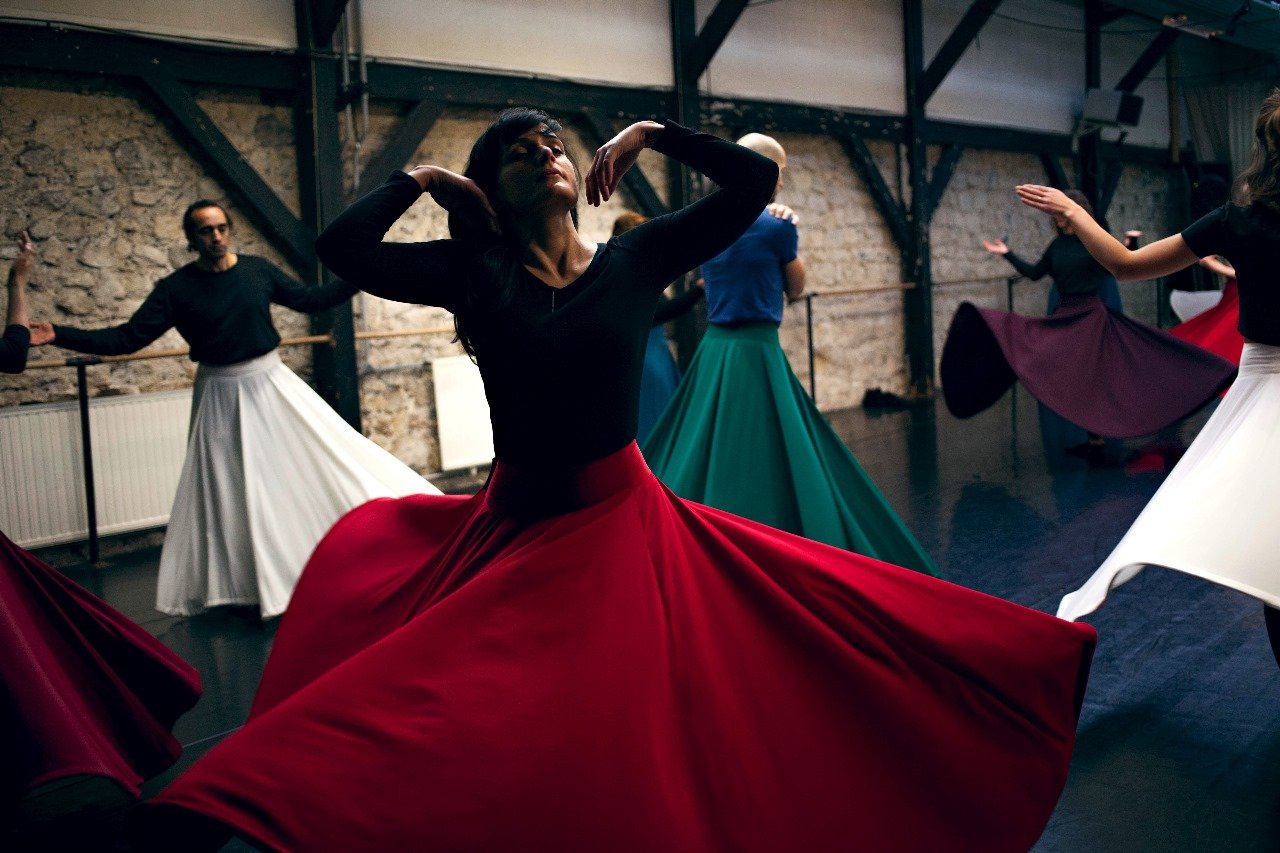
The long skirt, usually white as a symbol of purity, makes it possible to highlight the dancer's circular movement, It opens in a circular motion.
The Sufi dance is the dance of souls and reveals spiritual energy. This energy cannot be seen with the naked eye because it is elusive and its color is nothing other than a colorless light, pure and transparent like a mirror through which the world is reflected.
That is why the movements of infinite waves of the skirt allow to reveal the presence of the soul which, like an aura, envelops the body and floods it like the sun which offers its light to the earth, source of life without which we could not exist.
La Sufi music is repetitive, often built around Zekr (or Zikr) denotes both the memory and the practice that revives this memory. The rhythms remind of the heartbeat and the musical loops lead to Samâ and mystical intoxication.
Yes, you have to be a believer. You have to believe in love..
Love of oneself and others. Believe in ourselves above all and agree to follow this path, sometimes strewn with pitfalls, disappointment, discouragement but also with accomplished dreams and hope.
The rest is of no importance, because through this dance I offer the viewer the chance to see themselves as the reflection in a mirror… I am myself and a whole at the same time. It is a listening between oneself and others…
No previous dance experience is necessary. Anyone can learn and master the techniques of the turn while respecting their own rhythm and disposition. With time and practice, dancers improve the power and speed of their turns, pushing back their own limits.
No age restrictions.
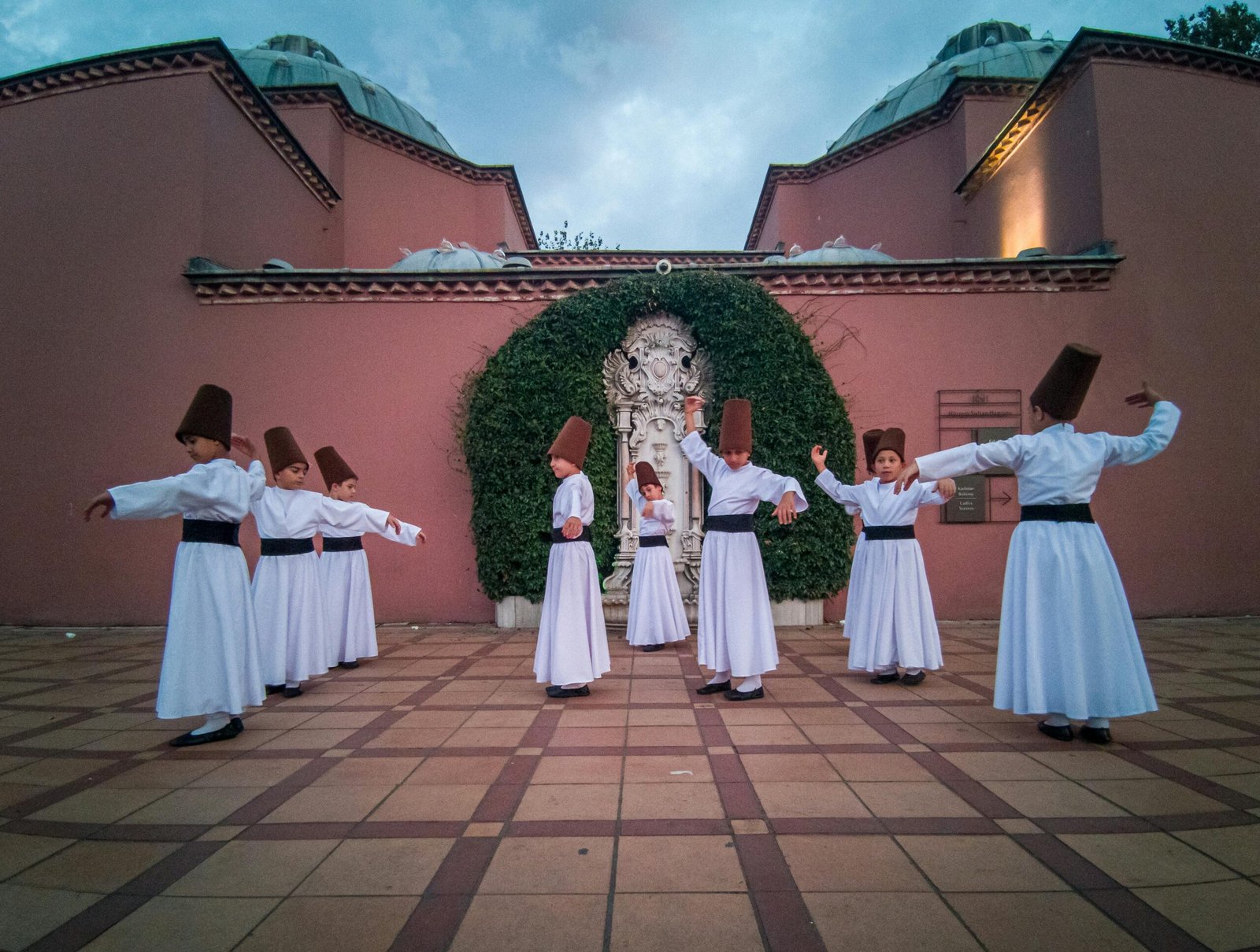
The Sufi dance is an instinctive dance. Moreover, we can notice that often children spontaneously turn and take pleasure in this sensation of vertigo.
Unfortunately, as we grow, we lose this spontaneity and momentum. That is why this dance, like a quest, brings us back to the sensations of being that were denied over the years and the life course of each human being.