
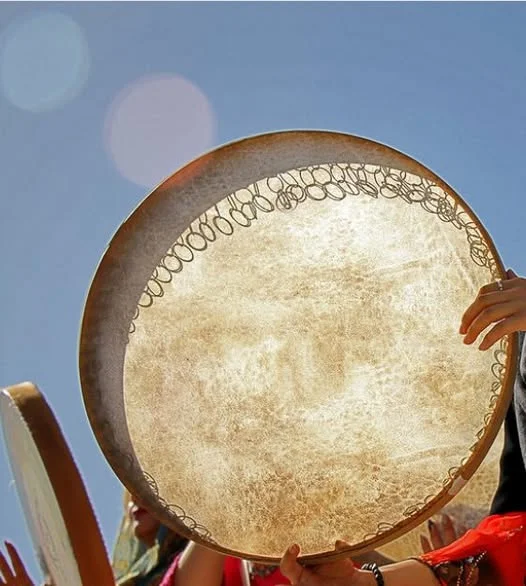
Of Kurdish origin, this large circular drum is a musical instrument generally characterised by rings nailed to the inside of its wooden frame.
Today, it's mainly played in the Middle East.
In Sufism, it embodies mystical love*. Rûmi, a 13th-century Persian poet, celebrated it in his verses:
«The daf said: “Hit me on my face,
The more you hit me, the more stories I'll tell you
I'm in love and, like all lovers, lovable
If you hit me, if you hurt me, I'll talk to you like this”.»
It is said that the spherical shape of this instrument represents the Earth and its rings, the human beings who inhabit it. The sound generated by these little metal circles banging on the skin of the daf symbolises the men and women who knock in vain at God's door.
Prisoners of their earthly life, beings can only free themselves from their condition through separation. By analogy, the rings are also prisoners of the daf. When one of them becomes detached, a soul is said to have gained eternity.
The daf is traditionally associated with Kurdish Sufi ceremonies. Thanks to the heady rhythm produced, the musician leads the dancer towards the ecstatic state he is seeking and helps to maintain the intensity of the Zikr*. His role is therefore essential. The daf player sees himself as an intercessor between the visible and the invisible: through the sounds that flow through him, he makes the heartbeat of God heard.
During the Sufi dance, There can be dozens of musicians. It also happens that a daf's skin tears. He then becomes a «shahid», meaning that he has served God and joined him as a martyr. In this case, the Sufis will organise a funeral to honour his soul.
If the daf is not buried, it will be hung on the wall. In memory of the manifestation of the divine. Today, these traditions are tending to disappear, but they are still present in Kurdish villages in Iran and Iraq.
Sufis believe that the daf has therapeutic virtues. According to them, its vibrations purify the body and heal pain, but they also improve the condition of people suffering from depression or melancholy.
To heal the «sick» person, the daf players surround and cover him or her with a white sheet to protect the soul. These practices, which are free of charge, are always supervised by the Sheikh, a spiritual master.
Playing the daf allows you to enter another dimension: Sufi rhythms all have names referring to the divine or to nature.
For example, Hay Allah («God is alive») is played at the opening of the ceremony. This slow rhythm, punctuated by evocative silences, marks the irruption of the invisible. It invites us to embrace the mystery...
Daem («continuous») refers to the infinite cycle of life, but also to the strength of galloping horses.
Each rhythm takes us on a journey through a story with a deep connection to Sufi spirituality.
So let yourself be tempted. Live the experience!
What is the Dervish Oracle?
It is a silent spiral. Each card is a step in an invisible dance where we join the rhythm of the world. The oracle is not static: it vibrates, it breathes, it allows itself to be tamed by slowness.